Tuesday, December 4, 2007

What Doesn't Breathe 2

Yesterday, driving home in the snow with four kids in the car, my daughter said:

"I know one of the kids in my class that had lice, mommy. It was [no grown up would ever tell]. I know because she had olive oil in her hair. Olive oil kills lice."

It does, how does it do that?
http://www.entm.purdue.edu/pittendrigh_lab/news/051207.html
"The oil clogs the bugs lungs so they die."

Turns out, I read this morning, while these six-legged creatures that breath through pores in their sides, are becoming immune to that toxic burning stuff we pour on our children (or our parents poured on us) nothing is immune to not breathing. Though they can shut down their systems for a while, so you have to leave it on. Have the kid wear old clothes -- and don't dip them with French bread -- that's just gross.

Monday, December 3, 2007

What Doesn't Breathe

Fact of the day:
In this country we go through an estimated 100 billion plastic bags a year.

It takes about 12 million barrels of oil to make those bags.

Less than 1-5% are recycled each year.
It can cost $150 for a city worker to get a bag out of a tree.
Antarctica is littered with plastic bags.
The bags are virtually non-biodegradable -- and when they do break down, they leach toxins into the soil.
An estimated 100,000 sea creatures die each year eating them or getting tangled up in them.

bird
http://www.alternet.org/environment/61607/

25 children still die each year in the US at the hand of plastic bags.

All of this has to do with plastic -- the properties of plastic. That it does not breathe. That we are making a society -- for animals for soil for air for children -- that blocks breath.

Randy Cohen, the writer of the "Ethicist" column in the New York Times, was in this great little film on the oil drum this weekend. I tried to post it but it was locked in place. (Good for them.) http://www.theoildrum.com/

He said that left to our own devices we are bound to act lazily and for personal interest. (He wasn't talking about bags here, so I'm paraphrasing. He was talking about traffic). But he went on to say that it was in all of our best interests to be required to do the right thing. A very democratic, paternalistic view of politics, it must be said.

But it can't really be argued these days that saving the environment is not in the public interest.

Here's another number -- retailers spend about $4 billion a year on those plastic bags. They are not free; consumers do pay for them. The reliance on the plastic bag fuels the reliance on foreign oil. Perhaps here in lies an argument for the free marketeers out there.

San Francisco banned plastic bags in stores, and in another 6 months the ban will go into effect in chain stores as well. This ban is expected to remove about 800,000 bags from the system in a year.

This is one area of greenery where California cannot claim to be the global leader. In Taiwan and Ireland, you pay for plastic bags. They have been banned already in Rwanda, Bhutan, Bangladesh (where they cause flooding by blocking drains), South Africa (where distributing them can land you in jail) and Mumbai. Paris will join the list at the end of this year, the rest of France in 2010.
http://www.economist.com/world/na/displaystory.cfm?story_id=8929506

I will take the reusable bags off the banister in the hall and use them.
And I will
go back to the car to get them when I get to the front of the line.

These numbers seem to be fairly widely reported. Number for this entry came from reports in the Times, The Globe and The Economist, among others. No one seemed to cite sources.

Sunday, December 2, 2007

Fish Oil

Scientists have been studying fish oil as the best source for omega 3 fatty acids. Fish oil has been the subject of studies revolving around brain chemistry -- and is shown as a leading preventative medicine for everything from depression and bi-polar disease to Altzheimer's -- memory loss to blood clots.

The American Heart Association recommends eating fish 2-3 times a week for all the great health benefits and low-fat source of protein. Tuna is one of the best sources of this oil.

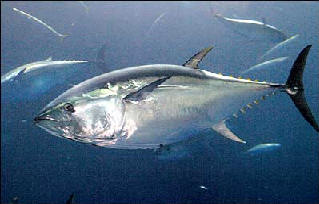
bluefin tuna underwater

On another site, I found a handy mercury calculator. It takes your weight and the weight of the fish you think you will be eating in the near future, and calculates the percentage of mercury on the scale of recommended weekly allowance. The mercury in tuna is concentrated because it's concentrated in the fish they eat.

http://www.gotmercury.org/

Ahi Tuna is my favorite. I was conservative and said I would be eating an 8 ounce steak this week. That would constitute 290 percent of my recommended weekly allowance of mercury. When I was in Hawaii several years ago I ate Ahi tuna every day. It was fresh and perfect -- sometimes I ate it twice a day. Again being conservative I thought I would see what kind of percentage I ingested in my week long stay there if I had one 8 oz. piece of fish five days in a row. One thousand four-hundred seventy.


The worst number -- I plugged in what a half can of canned albacore tuna means to my daughter. One hundred and seventy percent of her weekly mercury intake.

Remember as kids we used to drop a mercury thermometer and every body would freak out because what would be done with that one little drop of mercury? No one would eat it, of course -- wasn't the deal that it would burn your skin off?

Let's remember now, mercury is released into the ocean from the drilling, piping and refining of oil. It takes one perversion of natural resource to make another.

Saturday, December 1, 2007

A Hellish Thing

Last week, the Audubon released a study called "Watchlist 2007" placing 178 species of North American birds on the list of those in peril of extinction.

While the Watchlist only reports peril causes for some on the list, a New York Times editorial this morning reads:

According to this report, called WatchList 2007, nearly a quarter of the 700 bird species in America are threatened, usually by direct human economic activity, like development and gas and oil production.

In a related article in the Times, Anthony DePalma reported:

“We’re concerned that there’s been almost a moratorium on the listing of endangered birds over the last seven years under this administration,” Greg Butcher, Audubon’s bird conservation director and a co-author of the new study, said in a telephone interview. Placing a threatened bird on the new watch list can bring it the kind of attention it needs to survive even if the federal government does not act, he said. “When we pay attention to these birds and do the things we know need to be done, these birds recover,” Mr. Butcher said. “All these birds have a chance to rebound if we put the right actions in motion.”

So something can still be done, and our current administration may have put a block on public notification. Our administration who has some vested interest in the oil industry, I believe...


The list includes several species of Albatross.

The Albatross was the bird that symbolized Christ and Hope and the coming land in Coleridge's "Rhyme of the Ancient Mariner."

And I had done a hellish thing,
And it would work 'em woe:
For all averred, I had killed the bird
That made the breeze to blow.
Ah wretch! said they, the bird to slay,
That made the breeze to blow!

The Mariner is then forced to wear the dead albatross as penance around his neck. Lots of death and destruction ensue, with a bit of redemption thrown in at the end.

This is the same poem that utters the often repeated words, "water water everywhere and not a drop to drink."

It seems almost entirely a prophetic poem this bright blue morning, the first of a warm December. As if Coleridge were warning us of the game being played for our death and our life in death as the result of our actions.

In college when I was reading this poem critically for Ms Pat Skarda, I killed a fish. I had just put my dog to sleep and thought that maybe a fish would be some kind of less responsibility requiring company. But the new pet was acting strange, and, still traumatized from the loss of the dog, I flushed the fish down the toilet. I asked my roommate to make me a necklace with a black fish sculpted out of modeling clay to wear in penance. I wanted to feel the weight of my guilt around my neck.

Sometimes it's not a bad thing to live with that responsibility for a while.

And through that action what we remember to regard what surrounds us as beautiful life, just as the Mariner saw with fresh eyes the dolphins and the whales surrounding his ship by the end of his journey.

Friday, November 30, 2007

Corn Dump Hours

When I was between the ages of 8-11 or so, I lived in Maine, on 17 acres of land. I have been thinking about that time a lot lately -- about the ghost in the woods, the small old family cemetery near the brook, and the snakes that lived in the wood pile.

My mother designed the house we lived in and built it together with a carpenter whose name I can't remember, but he had a great laugh. The house was heated by a Russian fireplace, fueled with trees cleared for the building. We used water from a well in the front yard.

My mother also gardened. Down by the road, about a quarter mile from the house, she had a whole acre garden. I hated it -- though there's nothing like the taste of corn picked, then eaten immediately, raw for breakfast. Corn is hard on the earth though, and you have to rotate where you plant it each year because it sucks all the nutrients out of the earth.

The sugar in corn is what makes it such a good fuel.


Lynn L. Walters for The New York Times

Today I strayed a bit, to begin to learn about ethanol. Ethanol is not oil. Ethanol is seen as the leading replacement contender to oil. Ethanol production -- energy made primarily from corn -- is on the rise. It's so on the rise that there's been a bit of a glut on the market this fall.

The Times reported in September:

About 1,000 pumps at the nation’s 179,000 gasoline stations offer gasoline blended with ethanol...Congress essentially legislated the industry’s expansion by requiring steadily higher quantities of ethanol as a gasoline blend, a kick-start that was further spurred by the proliferation of bans on a competing fuel additive used to help curb air pollution.
http://www.nytimes.com/2007/09/30/business/30ethanol.html?_r=1&oref=slogin


Nate Hagens, a PhD student at the UVM Gund Institute for Ecological Economics, reported on The Oil Drum this morning:

Recent increases in oil prices in conjunction with subsidy policies have led to a dramatic expansion in corn ethanol production and high interest in further expansion over the next decade. President Bush has called for production of 35 billion gallons of ethanol annually by 2017, which, if achieved, would comprise about 15 percent of U.S. liquid transportation fuels. This goal is almost certain to result in a major increase in corn production, at least until marketable future alternatives are developed.
http://www.theoildrum.com/node/3285#comments

Recently, a book was published by the National Academy of Sciences about the implications on the environment of the growth of these programs. It's not good. Both water use and degradation will be huge -- fertilizer and pesticide use. The taxing of the land.
http://www.nap.edu/catalog.php?record_id=12039

I think it's time to invest in a tandem bike for commuting with the kids.

Thursday, November 29, 2007

My Credit Card

The lede on the front page of the Times yesterday read:
Flush with petrodollars, oil-producing countries have embarked on a global shopping spree.

Just in time for shopping sprees here at home -- 'tis the season.

Yesterday, Wednesday, Nov. 28, The Abu Dhabi Investment Corp. firmed plans to spend $7.5 billion and become the largest single share holder in Citigroup.

The issue of stockholder percentage has to do with who has control over the company; as in, who makes the decisions for a company -- who are company decision makers responsible to. Stockholders. While the ADI will still only own 4.9 percent of Citigroup at the end of the deal, it still seems to me to bring globalization home.

The "What's in your wallet" slogan comes to mind... Citigroup is in my wallet.

Reuters reports this morning:
The sale to the $650 billion Abu Dhabi Investment Authority, the world's largest sovereign wealth fund, may also signal the freefall in U.S financial stocks is close to ending, analysts said.

I don't know, the shoring up of a huge American financial institution seems like a good thing to me. But there's something extremely uncomfortable in the connections between oil prices soaring, stocks plummeting and the situation in the Middle East.

My credit card. My debt. My heating oil. My needs.
Again, do we kill -- as in drain the life force from -- that which we define, own, desire to control.
Oil wealth.
Somehow I can't figure a way to put that into a "my" sentence. And yet, there seems to be a lot of killing going on.

Wednesday, November 28, 2007

The Prize Ultimately Lies

A fact a day… for the past few they’ve been feeling more like lessons than facts. Today I learned a fact from an NPR broadcast just a few weeks old:

The American military is the single-largest purchaser and consumer of oil in the world,
guzzling about 340,000 barrels of oil a day.

Now I remember that $100 marker.
Now I remember the doubling of oil prices.
Now I remember that yesterday I was wondering if I should give up driving out to the organic farm in Concord.

“If the Defense Department were a country it would rank about 38’th in the world for oil consumption, right behind the Philippines.” (Morning Edition, November 14, 2007)

One plane they talked about runs on 3 gallons per mile. No, I didn’t type that wrong. 3 gallons per mile. The military is not concerned about having their budget cut – obviously, we are in the middle of a war, and it needs to be continued...

The bigger challenge for the military, O'Hanlon (a former Defense Department budget analyst who is now with the Brookings Institution) said, is what the price hikes represent — a narrowing of the gap between supply and demand that could cause problems for the military down the road. What happens when such an oil hungry institution can't get oil?
http://www.npr.org/templates/story/story.php?storyId=16281892

This seems like an amazing little knot we have ourselves in in the middle east, then, no? I am pulling both the quote above and below from larger articles, and isolating them to make my point, but I am taking neither out of context... I have been reading and rereading an article from The Independent from last January entitled, “The Spoils of War.” The article has lots of information about the future of Iraqi oil I'm trying to get my mind around, but in terms of our history there:

Vice-President Dick Cheney, who said in 1999, while he was still chief executive of the oil services company Halliburton, that the world would need an additional 50 million barrels of oil a day by 2010. "So where is the oil going to come from?... The Middle East, with two-thirds of the world's oil and the lowest cost, is still where the prize ultimately lies," he said.
http://news.independent.co.uk/world/middle_east/article2132569.ece